
At a glance

Who is Saban Community Clinic
Saban Community Clinic is a non-profit healthcare organization serving the Los Angeles, CA area across five locations. Its team of doctors, nurses, medical residents, and other healthcare professionals is committed to blending innovation with compassionate care—and as patient demand has grown, keeping administrative work from crowding out that care has become critical.
The challenge
Referrals are one of the most common ways patients reach Saban—thousands each year. Every one of those referrals depended on providers switching between multiple systems to verify eligibility, coordinate insurance, and process the handoff. Each step was manageable on its own; at volume, it pulled staff time directly away from patients.
Saban's data quality team saw an opportunity to change that, and brought in R-Path as a partner to build their automation program from the ground up.
What R-Path built
R-Path started by mapping the referral process end to end—working directly with Saban's staff to document how each part of the organization's referral workflow actually worked before automating any of it.
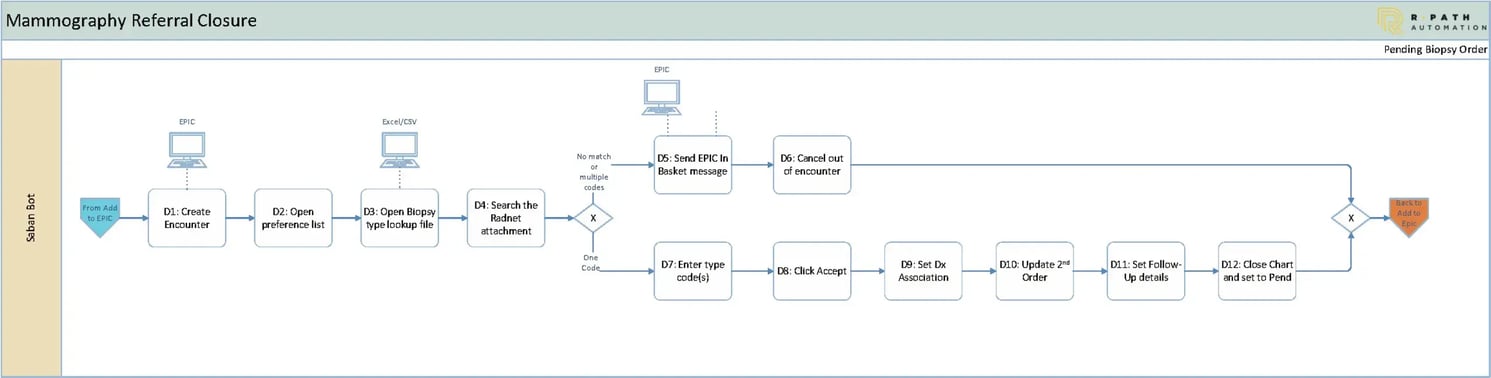 Process map image from full PDF, page 2 — A portion of a process map for one of Saban's completed automation projects. Even a single referral sub-process, like mammography network referral closure, involves a dozen-plus discrete steps across multiple systems.
From there, R-Path and Saban prioritized which sub-processes to automate first—starting with the ones consuming the most staff time and touching the highest volume of patients. The resulting bots now run across 15 of Saban's internal and external software systems, handling high-volume, low-variability referral steps automatically. When a case falls outside the bot's instructions, it's routed straight to a Saban team member—the bot handles volume, staff handle judgment calls.
The two teams have kept working together as Saban's own systems evolved. When Epic—the clinic's core medical records platform—underwent a major update, R-Path reviewed the change alongside Saban to catch anything that could affect the automations before it caused a problem.
The results
Since the program began, Saban's referral bots have processed thousands of referral orders—many of them outside business hours, on time that would otherwise have gone to administrative or patient-facing staff.
- 15 internal and external systems now running automated referral workflows
- $20,000+ in estimated savings, and growing as the automations continue to run
- 1,000 hours saved in the first six months
With that administrative load reduced, Saban's team has been able to put more of its attention back where it matters most: patient care.
In their words
R-Path's relationship with Jared Friedman goes back to 2019. When Jared joined Saban Community Clinic in 2022, he brought that trust with him—and R-Path became Saban's automation partner from day one of the program. "Jared understands the potential efficiency gains that a properly run automation program can bring to an organization," says Jim Frost, R-Path's Lead Engagement Partner. "He understands that deploying technology solutions is necessary to meet ever-changing priorities and workforce constraints that can't be solved by simply hiring more people."
What's next for Saban
Saban's automation program continues to expand — from rate reconciliation and vaccine ordering to automated reporting and additional referral sub-processes — as the organization looks for more ways to keep administrative work off its care teams' plates.
What can automation save your team?
If your team is losing time to referral processing, eligibility checks, or other high-volume administrative work, let's talk about what automation could look like for you.

Related: Healthcare industry page · Healthcare automation guide